Reform of the Charter of the French Language
The exception does not prove the rule
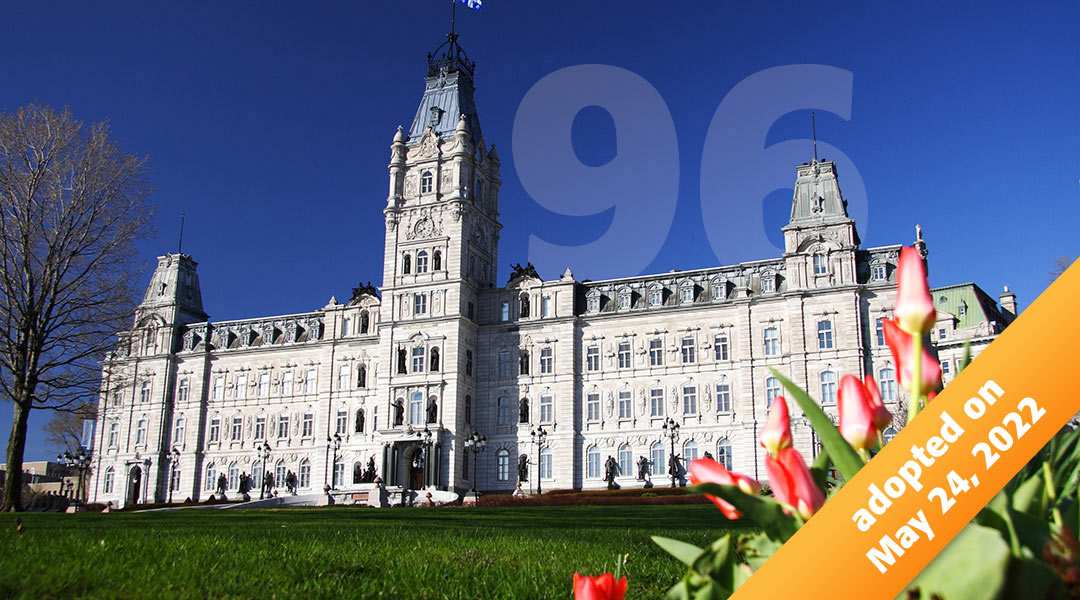
Bill 96, which was adopted on May 24, 2022, claims to reform the Charter of the French Language (CFL) 45 years after its adoption. “The law we are adopting today represents the beginning of an important linguistic revival that will enable the Quebec nation to continue to fully express its identity and values,” Minister Simon Jolin-Barrette said. He is backed by the Premier who called the law “responsible” and “moderate.” Time, rather than politicians, will tell whether this renewal will have the expected effect, but we doubt it. In this, we join the numerous experts who have voiced their concerns.
In our opinion, the Bill is a pointless exercise that will have no major effect on the vitality of French in Quebec and on the influence of francophones in Canada. However, it will have detrimental effects on Quebec’s international reputation and its economy. This Bill is designed above all to impress Quebec francophones and prove to them that their government is assuming its historic responsibilities to protect the French language. And it is successful because the illusion is complete. The public to which this illusion is directed is applauding an aggressive Bill in which the designated culprits are, in this case, businesses and bilingualism. It avoids asking questions about the real causes for the decline of French in Montreal, which francophones have deserted for the suburbs, and about the collective responsibility of the public for the French language. The invasive digital culture does nothing to improve the situation.
Companies are the designated culprits of this public relations political campaign. The part of the law about francization of companies is not truly improved. This concerns companies’ relationships with their employees and clients in Quebec. Most companies already work in French because 89% of employees used French in 2016, according to a study by the Office québécois de la langue française (OQLF). If this number has dropped over the years, it is because English has become necessary in the science and technology sector. Between 2006 and 2016, the predominant use of French in Montreal dropped from 72.2% to 69.6%, but the use of English also diminished. More and more workers in Montreal now use just as much French as English. Therefore, it is the increase of “bilingualism” in Montreal workplaces that explains the slight drop in the predominant use of French by Quebec workers.
Is it necessary for the law to attack bilingualism in order to conserve French by appointing the OQLF to monitor businesses that require the knowledge of a language other than French? Certainly not. Because logically, it would have no effect on the French language. If the requirement is unnecessary, no one will speak English instead of French, and if it is not, it is because English will be necessary for communication outside Quebec. As for unilingual francophones who would not be hired because bilingualism is needlessly required—they do not exist! No employer has the means to refuse a qualified candidate during this time of sustained labour shortages. By attacking bilingualism, the law is attacking the economy and Quebec’s relationships with the outside world. And if the attitude of the OQLF today is an indicator of the future, the businesses being badgered are those conducting business outside Quebec.
In three years, the law will extend the obligation to generalize the use of French to employers of more than 25 people and it will soon oblige those employing a minimum of five people to offer non-francophone workers French courses from Francisation-Québec. There is no need for a law to achieve this because it would suffice to add a regulation to the Charter defining the notion of company and to use the opportunity to stipulate that a franchiser and its franchisees comprise one and the same company. Instead, the OQLF will have to continue francizing each legal entity connected to a franchiser one after the other and certifying all registered divisions of the same company one after the other. This is an inordinate waste of resources. As for Francisation-Québec, sufficient budgets would have allowed it to fund French courses not offered in some regions, which would have enabled it to achieve the francization objective without modifying the law.
For the rest, it needlessly shortens the filing deadlines for reports and forms, imposes an onerous double representation at the head of francization committees, and wants to prevent companies from being represented by experts with the Office québécois de la langue française. Most of the additions to the law are merely good administrative practices that the OQLF could have imposed, such as issuing minutes of francization committee meetings. The OQLF is at least two years behind in processing its files! Why shorten these deadlines for companies unless it is an effort to crack down?
There is the law and then there is the body that enforces it. These are two different things. The law applied is not always the one voted on. It all depends on the way the person applying it understands it.
The OQLF has difficulty understanding that a business established here might not use French as its dominant language in its daily conversations unless its headquarters date from the 1980s. According to OQLF logic, any business established in Quebec must be able to generalize the use of French. Businesses that are the exception to these definitions are clashing pointlessly with this body that seeks to francize them at all costs even though they have no clients here and work daily with their colleagues and clients outside Quebec in English, of course. The OQLF says it is taking their situation into account, but again it raises the issue of generalizing French and is unable to comprehend that the CFL cannot apply to businesses that clearly breach the law by necessity and must always use English as their language of operation. These are exceptions of course, but they need to be recognized as such because rigid rules and interpretations create injustices toward those who cannot meet the standard.
The CFL reform would have been an opportunity to slightly improve the obsolescent situation of this part of the Charter, especially Section 144, which concerns exemption to the generalization of French. Not all companies are able to generalize the use of French without unfortunate consequences for their business. This is not about English-speaking bosses who make their employees work in English for their own personal comfort. These are innovative businesses, some of which are recruited by Montréal International, that bring projects and businesses with international scope to Quebec. These are also Quebec businesses that were developed on foreign markets and have very few clients, if any, in Quebec. These businesses provide paid jobs. Some raise Quebec’s profile across the world and must remain competitive on an international scale. They do not represent even one percent of all those that must generalize the use of French. But they are the ones being badgered by the Office.
The current reform of the Charter of the French Language avoids updating Section 144 and its regulations. Section 144 still refers to headquarters that threatened to leave Quebec as soon as a sovereigntist party gained power at the time the Charter of the French Language was adopted. This constrains its application, leading to situations whereby the OQLF requires businesses that are not headquartered here but only do business outside of Quebec to generalize the use of French, without providing a practical solution to this problem. In addition, the rules of application refer to sections of the CFL that no longer exist. Nonetheless, the most awkward aspect is the relentless desire to francize businesses that are unable to do so. Section 144 allows exceptions to the obligation to generalize the use of French in business relations outside Quebec through special agreements with the OQLF, while additionally imposing francization measures that protect the rights of employees, consumers and citizens to communicate in French. The agreement allows for working in English outside Quebec while respecting the basic elements of the Charter. However, this section is not often used because the Office would like to eliminate all special agreements.
Yet, it is an essential element of the Charter of the French Language and could have proven all the flexibility and adaptability of the law where required by the situation. Section 144 and its regulations required modification, but this was carefully avoided, leaving this part of the law in the dilapidated state it is still in today. In our opinion, this is proof that Bill 96 was more of a political exercise than a true reform of the Charter of the French Language.
Contact us. We have solutions for you.
Chantal Larouche
President, GP Conceptal Inc.
 514 347-3984
 chantal@gpconceptal.com
 gpconceptal.com